From Forest to Customer: A Wood Procurement Board Game
When I started learning about wood procurement, I realized that getting timber from the forest to the customer involves a lot more decisions than I expected. Timber quality, storage, transportation, road conditions, and customer requirements can all affect the process, and they all affect each other too (Finnish Forest Industries Federation, 2021).
I wanted to turn these decisions into something more interactive, so I designed and built a physical board game about wood procurement.
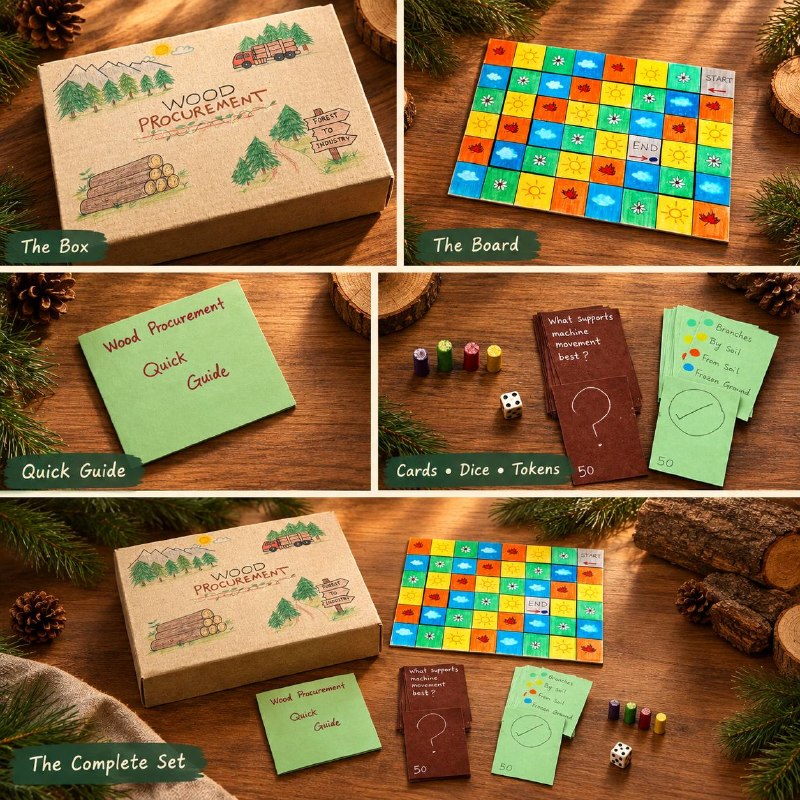
Figure 1
The “Wood Procurement” board game: the box, board, quick guide, cards, dice, tokens, and the complete set
Note.Physical game creation and game design by Saina Hajizadeh, 2026. Professional photography with ChatGPT (OpenAI, 2026).
The idea
The game follows a simple journey:
Forest → Roadside Storage → Transportation → Customer
The player takes the role of a person responsible for organizing the procurement process. The goal is to reach the end of the board by making good decisions along the way, and, as I’ll explain below, the season you are standing in changes what a good decision is.
A board built on the seasons
This is the part I’m most excited about. The board is a path of colored squares from START to END, and every square carries a season symbol: a flower for spring, a sun for summer, a red leaf for autumn, and a blue cloud for winter.
Here’s why that matters: wood procurement doesn’t happen in a vacuum. A transportation problem in winter isn’t the same problem in summer. Road conditions, storage timing, and even customer demand shift with the season. So instead of one fixed “correct answer” per question, the answer depends on which season square your token is standing on.
Two decks of cards:
- 🎴 Question Cards (the brown ones) present the situation.
- ✅ Answer Cards (the green ones) hold the correct responses, but each question has a different correct answer for each season. So the same question can have four different “right” answers depending on whether you land on a spring, summer, autumn, or winter square.
This is what makes the game feel less like a quiz and more like real procurement work, where the right call always depends on context.
How a turn works
- Roll the dice and move your token forward that many squares.
- Draw a Question Card.
- Answer it based on the season of the square you landed on, then check your answer against that season on the Answer Card.
- Depending on how you did:
- Fully correct, you earn the points on the card, and you roll the dice again.
- Wrong, you move backward the same number of squares you had just rolled.
- Partially correct, you stay exactly where you are, and the dice passes to the next player.
I like this system because it doesn’t just reward “knowing the answer.” It punishes overconfidence, rewards getting it fully right, and still keeps things moving when someone gets it half right. You’re never just answering a question, you’re answering it for this season, on this part of the route.
An example question
Here is one of the questions from the game:
🎴 Question Card
What supports machine movement best?
The Answer Card lists options like branches, dry soil, and frozen ground, and the right one depends on the season. On dry summer ground, the soil itself can carry the machine. In winter, frozen ground does the job. On soft, wet ground in spring or autumn, branches laid on the route can make the difference. Same question, different season, different best answer.
Four types of questions
The questions themselves cover four areas of wood procurement:
- 🪵 Timber, quality, volume, assortment, and customer requirements.
- 📦 Storage, roadside storage space, location, and timing.
- 🚛 Transportation, roads, weather, trucks, and distance.
- 🏭 Customer, orders, quality requirements, and changes in demand.
These areas connect to each other. A change in the customer’s order can affect transportation, while road conditions can affect when timber can be delivered. In real work, digital services such as Metsään.fi give forest owners and professionals the information they need to plan work across the year (Finnish Forest Centre, 2026).
The prototype
I built the first version of the game physically, and I wanted it to feel like a real product. It comes in a hand-decorated box with the title “Wood Procurement” and a “Forest to Industry” signpost on the lid. Inside are the board, a Quick Guide with the rules, the question and answer cards, dice, and four colored wooden tokens.
The scoring isn’t meant to represent real timber prices, it’s just a way to show that different decisions, in different seasons, lead to different consequences.
What I learned
Designing the game helped me see wood procurement as a connected, ongoing process rather than a group of separate tasks that happen once and are done. Adding the seasonal layer pushed that even further, it’s not just “what’s the right decision,” it’s “what’s the right decision right now, in this season, on this part of the journey.“
Instead of asking:
“What is wood procurement?”
the game asks:
“What would you do in this situation, this season?”
That’s the core idea behind the project: turning what I’ve learned in the Wood Procurement module into something practical, interactive, and hopefully genuinely fun to play.
I want to continue this prototype and give my classmates the chance to play with it and after receiving and evaluating the feedbacks, possibly present the idea to major board game companies.
References
Finnish Forest Centre. (2026). The Metsään.fi service. https://www.metsakeskus.fi/en/services/the-metsaanfi-service
Finnish Forest Industries Federation. (2021). Miten teen puukaupan? https://metsateollisuus.fi/uutishuone/miten-teen-puukaupan/
OpenAI. (2026). ChatGPT (GPT-5) [Large language model]. https://chat.openai.com