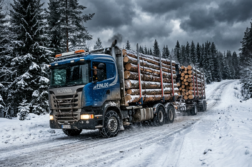
On September 23rd, as part of our Wood Procurement course and harvesting quality assessment assignment, our class visited an active logging site operated by Metsäkonepalvelu.
It was a fantastic learning experience! We were privilege to hear Roope Peuralampi and harvester operator VP Eronkoski share their deep industry expertise.
During the visit, we observed a powerful John Deere 1270G harvester in action—a true workhorse of the Finnish woods.
The Eye-Opening Fuel Reality
What struck me most during the field demo was the sheer scale of fuel consumption required by heavy forestry machinery.
The John Deere 1270G burns over 15 liters of diesel per hour. Its massive 450-liter fuel tank is only enough for a single day of full-capacity operation. At current Finnish diesel prices, fueling up just one harvester for a day costs an astounding €1,200!
From Electric Trends to Hybrid Forestry
Having previously seen heavy industrial equipment in China adopt range-extended electric systems (where a diesel engine acts purely as a generator while electric motors drive the load), I began to wonder: Can we bring this high-efficiency hybrid technology into the forest?
A quick deep-dive revealed that Finland is actually hosting a pioneer in this exact space—Logset.
To see how standard diesel compares to cutting-edge hybrid technology, I selected a machine from Logset’s lineup with a similar capacity and weight class to the John Deere 1270G we saw in the field: the LOGSET 8H GTE HYBRID.
Here is what I found when comparing traditional diesel power against the hybrid future of forestry.
First things first, let’s take a closer look:
How It Works?
Conventional Diesel Harvester
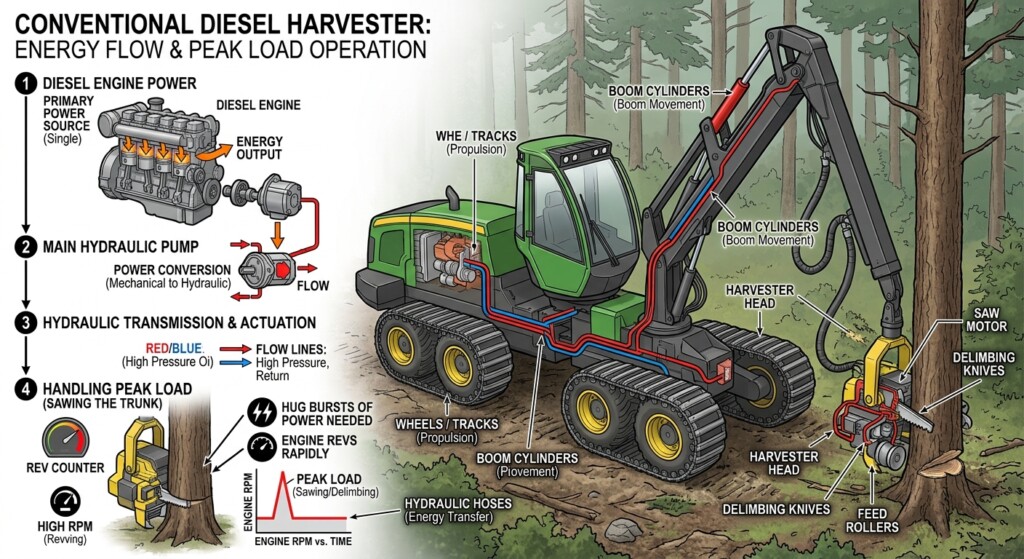
Traditional harvesters rely on a large diesel engine as their single power source. Energy flows through the following steps:
- Diesel Engine Power: The diesel engine drives the main hydraulic pump.
- Hydraulic Transmission: Hydraulic oil drives the wheels, operates the boom, and controls the harvester head (sawing, delimbing, and feeding trees).
- Handling Peak Load: When cutting thick or hardwood trees, the harvester head needs huge bursts of power. The diesel engine must quickly rev up to high RPMs to supply this peak power.
Technical Challenge: Forestry work has uneven workloads. High power is needed instantly for sawing and delimbing, while moving or idling requires very little power. This forces diesel engines to constantly switch to high, inefficient RPMs, causing fuel waste and higher engine wear.
Hybrid Harvester
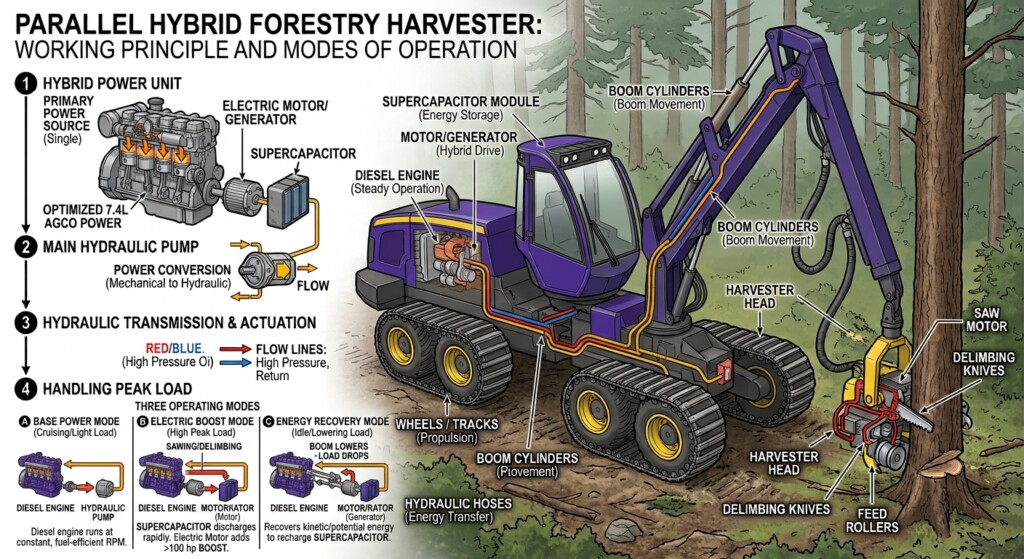
Hybrid harvesters (using a parallel hybrid system) add an electric motor/generator and a supercapacitor between the diesel engine and hydraulic system:
- Base Power: The diesel engine operates at a steady, fuel-efficient speed to cover baseline power needs without needing to handle extreme power peaks alone.
- Electric Boost Power: When the harvester head cuts or feeds trees, the supercapacitor releases electrical energy in microseconds. The electric motor delivers over 100 extra horsepower instantly alongside the diesel engine.
- Energy Recovery: When the harvester head slows down, the boom lowers, or load drops, the electric motor acts as a generator to store excess mechanical energy back into the supercapacitor.
Advantages & Disadvantages
| Feature | Conventional Diesel Harvester | Hybrid Harvester |
| Advantages | • Mature Technology: Simple setup with widespread parts and service support. • Lower Upfront Cost: No high-voltage electronics or supercapacitors. • Easier Repairs: Standard mechanics can perform daily maintenance. | • High Peak Power: Combined engine and motor output provides instant power with zero lag. • Fuel Savings: Reduces fuel consumption by 20%–30%. • Lower Emissions: Reduces CO₂ and nitrogen oxide emissions while cutting engine wear. • Instant Torque: Cuts through thick hardwoods without stalling or slowing down. |
| Disadvantages | • High Fuel Use: Requires a large engine to handle power peaks, leading to higher fuel bills. • Higher Emissions: Frequent revs lead to incomplete fuel burning and higher emissions controls. • Faster Engine Wear: Engine runs under constant heavy load spikes. | • Higher Purchase Price: High-voltage electrical modules increase initial costs. • More Complex Service: Requires technicians trained in both hydraulics and electrical systems. • Slightly Heavier: The hybrid drive components add extra weight. |
A Real Machine Example: LOGSET 8H GTE HYBRID 3.5 vs. John Deere 1270G
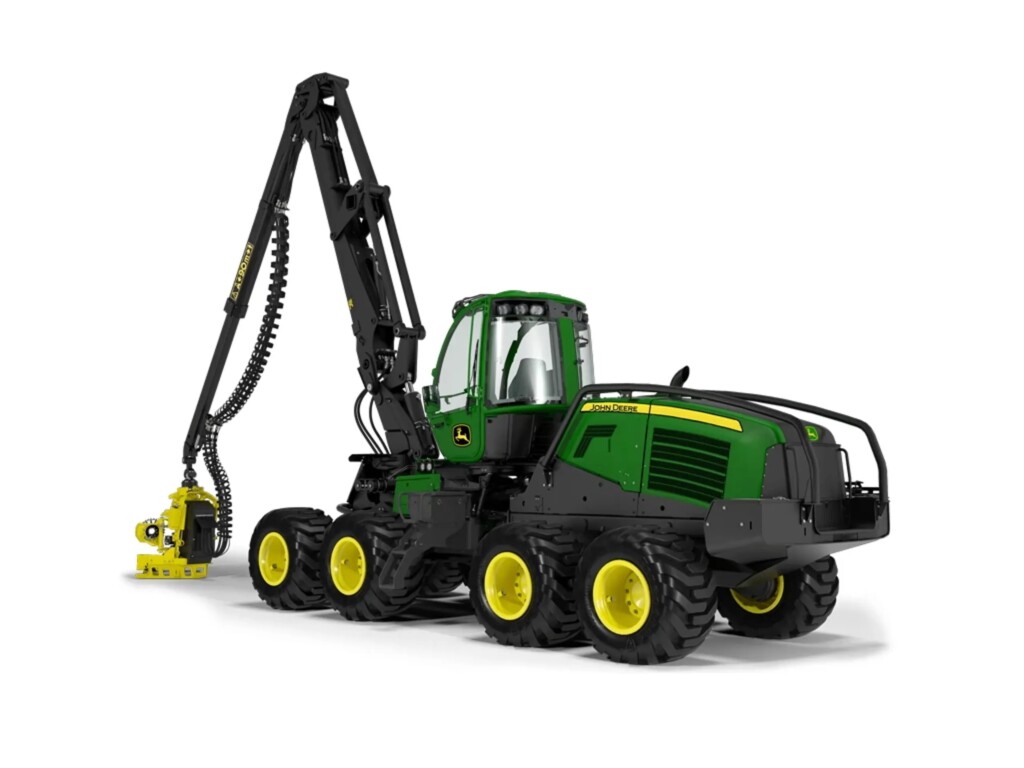
John Deere 1270G -harvester. (Source: John Deere / johndeere.fi)
To see these differences in action, here is a direct parameter comparison between the world’s first mass-produced hybrid harvester, the Logset 8H GTE Hybrid (3.5), and a similar-sized industry standard diesel harvester, the John Deere 1270G (8-wheel version):
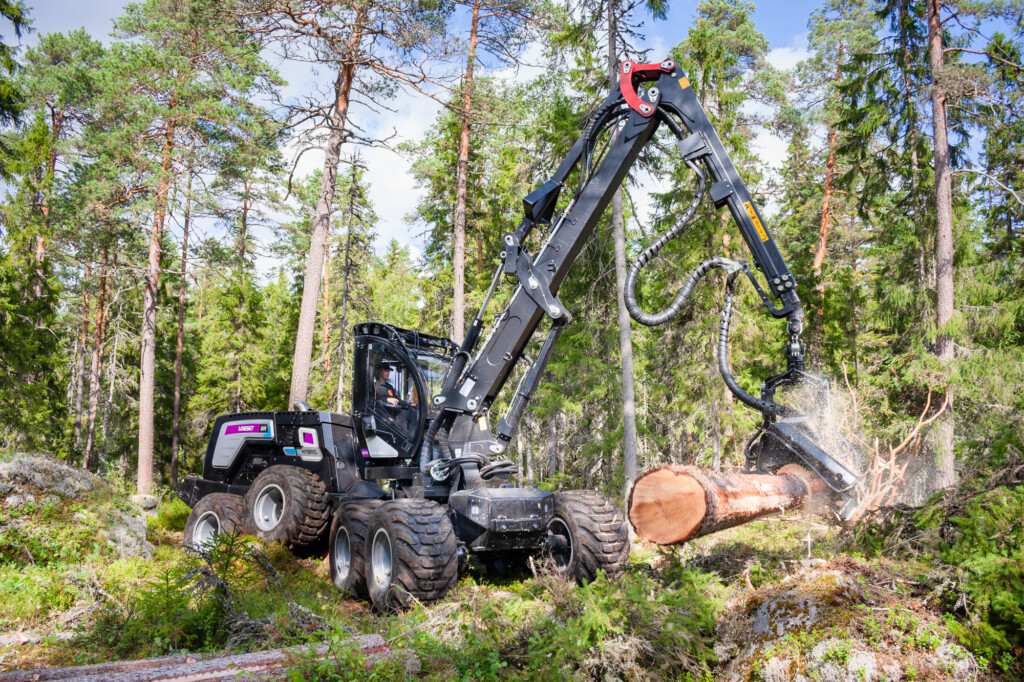
Logset 8H GTE Hybrid harvester. (Photo: Logset Oy, source: logset.fi)
Parameter & Performance Comparison
| Feature / Metric | LOGSET 8H GTE HYBRID 3.5 (Hybrid) | John Deere 1270G 8-Wheel (Diesel) |
| Engine | AGCO Power 7.4L 74 LFT (6-cylinder) | John Deere PowerTech™ Plus 9.0L (6-cylinder) |
| Engine Rated Power | Approx. 291 hp (214 kW) | Approx. 268 hp (200 kW) |
| Electric Motor Boost | +175 hp (130 kW) (via Supercapacitor) | None (0 kW) |
| Total Max System Power | Over 510 hp (373 kW) | Approx. 268 hp (200 kW) |
| Max Torque | System total torque over 2,000+ Nm | 1,315 Nm @ 1,400 rpm |
| Energy Storage | Supercapacitor (No battery degradation) | None |
| Fuel Efficiency | 20%–30% less fuel for the same amount of wood cut | Standard diesel consumption for its class |
By comparison, Hybrid Forestry Harvesters LOGSET 8H GTE HYBRID 3.5 offer the following advantages:
- Big Power from a Smaller Engine: Logset uses a 7.4L engine paired with a supercapacitor to generate over 500 hp total power. John Deere uses a larger 9.0L diesel engine, but maxes out at around 268 hp.
- Supercapacitors over Batteries: Logset uses supercapacitors instead of lithium batteries. Forestry harvesters require fast bursts of charge and discharge in milliseconds. Supercapacitors charge and discharge in seconds and last for millions of cycles without degradation.
- Higher Productivity: Thanks to instant electric torque, the Logset’s engine speed stays steady during tough cuts. This keeps tree feeding speeds fast and consistent, boosting productivity by 15%–20%.
Replacing conventional diesel harvesters takes time due to high equipment costs and long leasing contracts. However, with rising fuel prices and strict sustainability goals, hybrid technology proves that high performance and efficiency can coexist. Hybrid harvesters are not just a phase—they are the future of forestry.
Resources
Deere & Company. (2026). 1270G Wheel Harvester: Features and Technical Specifications. John Deere Official Website. https://www.deere.com
Logset Oy. (2026). Logset 8H GTE Hybrid: World-class Hybrid Technology for Forestry. Logset Official Website. https://www.logset.com (Finnish site: https://www.logset.fi)
Metsäkonepalvelu Oy. (2026). Responsible and Efficient Harvesting Services. https://www.metsakonepalvelu.fi