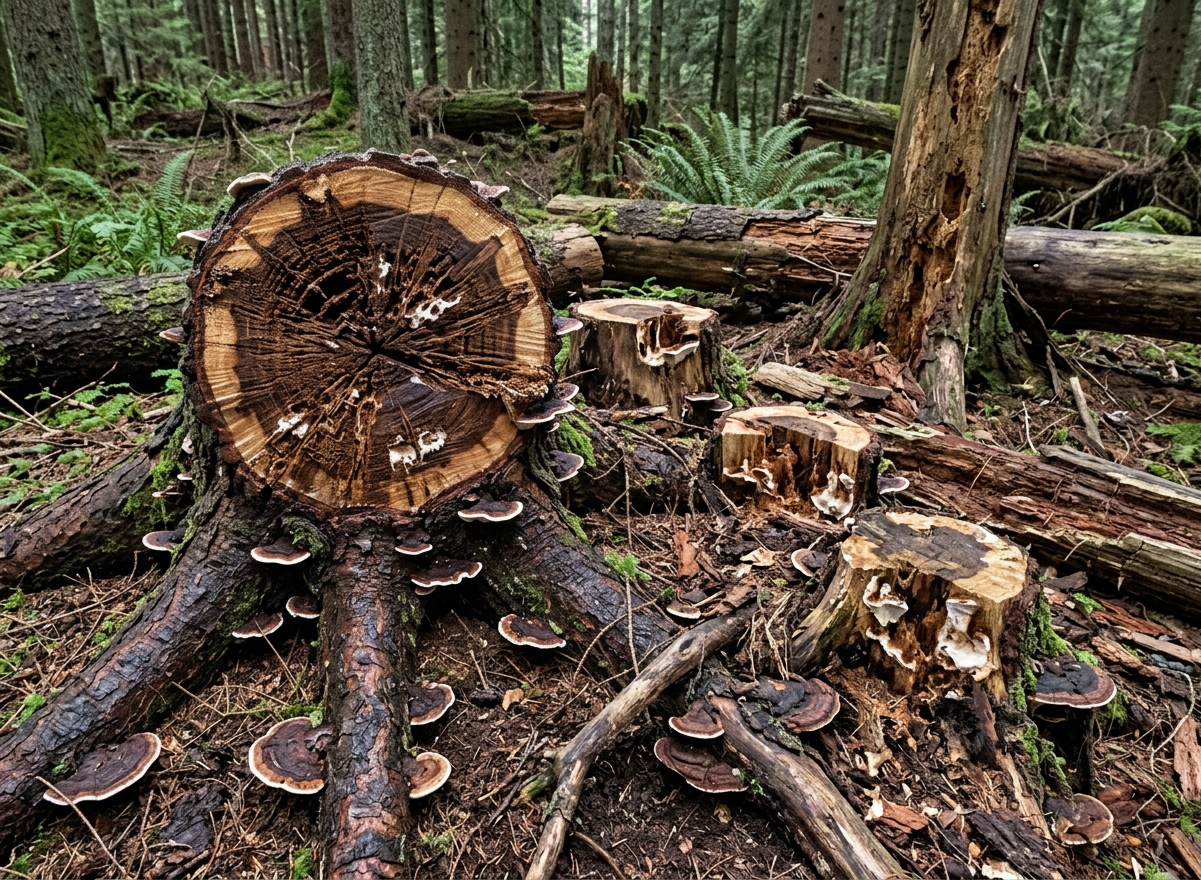
This fungus (juurikääpä) mostly lives in Eurasian conifer forests, specialized to infect Norway spruce but can also infect Scots Pine as well.
It causes root and stem rot, slowly killing trees from the inside. It is considered one of the most severe pathogens in northern Europe’s spruce forests (Garbelotto & Gonthier, 2013; Wen et al., 2019).
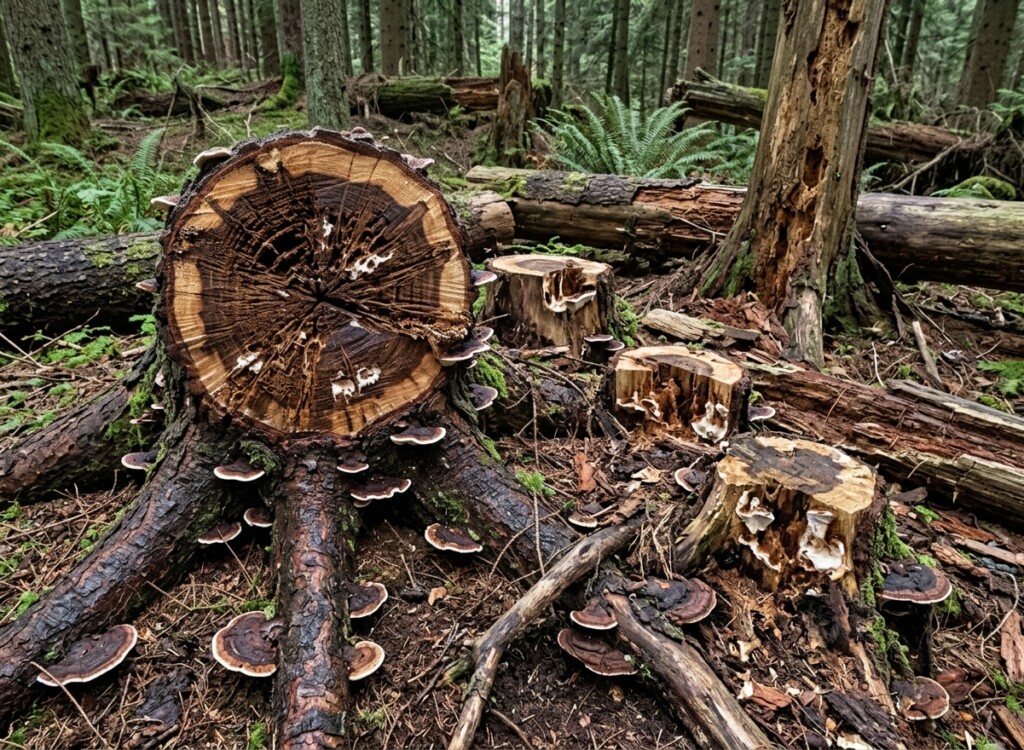
What are Fungi even?
Fungi are not plants. They don’t photosynthesize. They:
- Grow microscopic threads called hyphae, which form a network called mycelium.
- Secrete enzymes into wood and soil to digest it externally.
- Absorb nutrients back into their cells like tiny biological straws.
This external digestion is why fungi are such powerful decomposers and why wood decay fungi like Heterobasidion can be so destructive (Garbelotto & Gonthier, 2013).
How H. parviporum spreads
H. parviporum produces polypore bodies which are tough and shelf like on stumps or tree bases. They release basidiospores from tiny pores on the underside .
Infection strategy:
Airborne Spores
- Spores fly through the forest, especially in humid night air.
- Freshly cut spruce stumps are the perfect landing pads.
- Spores germinate and colonize the stump’s exposed wood.
Underground Spread
Once inside the stump, the fungus grows through the root system and spreads to neighboring trees via roots, forming long lasting disease centers.
This underground spread is why root rot can silently expand for decades.
Why this fungus is SO COOL (and deadly)
Modern genomic studies show that H. parviporum has hundreds of small secreted proteins that help it interact with host trees, compete with other fungi, and invade wood tissues (Wen et al., 2019).
Some of these proteins weaken tree defenses, kill plant cells, compete with other fungi, digest wood more efficiently aaalso manipulate host responses helping the fungus gain territory inside the tree!!
Some SSPs even trigger programmed cell death in spruce tissues, giving the fungus more dead material to colonize.
This fungus is not just a decomposer but a strategic necrotroph (kills then eats) with biochemical weapons (Raffaello & Asiegbu, 2017; Garbelotto & Gonthier, 2013).
Why Root Rot scares foresters and forest owners?
Root rot doesn’t just kill trees. It also:
- Reduces timber quality and value.
- Makes trees more vulnerable to windthrow and bark beetles .
- Spreads more easily in managed forests.
- Is expected to worsen with climate change (longer warm seasons = more spores) .
How are we combating it:
- The Friendly Rival: Phlebiopsis gigantea
Foresters fight fungi with other fungi.
Phlebiopsis gigantea is a harmless saprotroph (dead eater) that grows fast. It’s the active ingredient in Rotstop, a biological stump treatment widely used in Finland (Garbelotto & Gonthier, 2013; Verdera / Luke guidelines).
How it works:
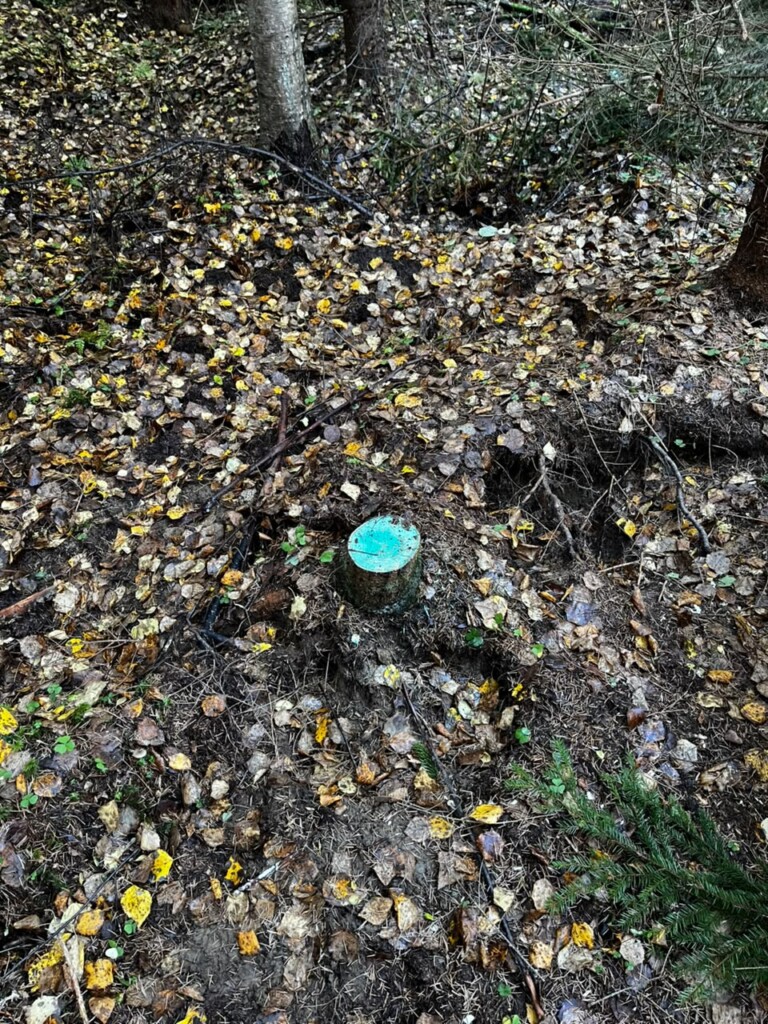
After a tree is cut, operators spray the stump with P. gigantea spores mixed with a blue dye(so they can see coverage).
P. gigantea colonizes the stump BEFORE Heterobasidion can.
It physically blocks and outcompetes Heterobasidion for space and nutrients
- New Research: Even viruses can help fight Root Rot
Scientists have discovered mycoviruses (viruses that infect fungi) and some of them weaken Heterobasidion.
HetPV13-an1 and HetPV15-pa1, reduce fungal growth and are being explored as future biocontrol tools (Umer et al., 2023).
What these viruses are
These are double stranded RNA viruses that infect fungi, specifically Heterobasidion annosum and Heterobasidion parviporum.
Some of these viruses make the fungus weaker which is called hypovirulence.
- HetPV13‑an1 slows fungal growth, disrupts the fungus’s normal biology, and even changes the activity of almost 700 genes. When the fungus carries this virus, it becomes much worse at invading living spruce wood.
THE CO INFECTION!
When the fungus is infected with both viruses at the same time something dramatic happens:
The fungus’s growth can drop by up to 95%!!
Researchers at Luke and the University of Helsinki are exploring how these viruses could be used as a natural, biological control method something they call virocontrol.
One virus HetPV13‑an1, acts like a “helper” boosts the spread of HetPV15‑pa1 between different fungal strains sometimes up to 90% transmission which makes it easier to spread the weakening effect through a whole fungal population.
And of course they have to be safe to use
Field tests show these viruses:
- stay inside Heterobasidion
- rarely move into other fungi living in the same stump
- don’t harm trees, animals, or soil organisms.
If you made it this far, Thank you and congratulations we are root rot experts now ^.^
Sources:
Garbelotto, M., & Gonthier, P. (2013). Biology, Epidemiology, and Control of Heterobasidion Species Worldwide. Annual Review of Phytopathology, 51(1), 39–59. https://doi.org/10.1146/annurev-phyto-082712-102225
Raffaello, T., & Asiegbu, F. O. (2017). Small secreted proteins from the necrotrophic conifer pathogen Heterobasidion annosum s.l. (HaSSPs) induce cell death in Nicotiana benthamiana. Scientific Reports, 7(1), 8000. https://doi.org/10.1038/s41598-017-08010-0
Umer, M., Mubeen, M., Shakeel, Q., Ali, S., Iftikhar, Y., Bajwa, R. T., Anwar, N., Rao, M. J., & He, Y. (2023). Mycoviruses: Antagonistic Potential, Fungal Pathogenesis, and Their Interaction with Rhizoctonia solani. Microorganisms, 11(10), 2515. https://doi.org/10.3390/microorganisms11102515
Wen, Z., Zeng, Z., Ren, F., & Asiegbu, F. O. (2019). The Conifer Root and Stem Rot Pathogen (Heterobasidion parviporum): Effectome Analysis and Roles in Interspecific Fungal Interactions. Microorganisms, 7(12), 658. https://doi.org/10.3390/microorganisms7120658